Environmental Religion

I bought some sparkling water in cans at Wegman’s. Then I noticed a 40¢ “carbonated deposit” charge on my grocery bill.
Huh? If I put sparkles in my water it costs me 40¢? That’s crazy! So I did a little research …
Massachusetts enacted the Bottle Bill in 1982. The consumer pays an additional 5 cents per container of carbonated beverages and can recover it by returning the empty container to a retailer or redemption center.
Non-carbonated cans and bottles require no “deposit”. Really? Don’t they pollute just as much?
Is it because carbonated beverages add carbonation? And CO2 (one of the most important elements for life) is bad? No. That false decree came later. It was to promote recycling. Did it? Not much. Massachusetts has the lowest redemption rate in the country, only 30%.
As it turns out, all unreclaimed recycling money funnels back to the state. Massachusetts made $73M in 2024.
And so, it is just another government money making scheme. That isn’t to say people don’t genuinely care about the environment. It makes them feel good even if it doesn’t help much.
Can and bottle redemption provides a kind of religious redemption on top of getting your own nickel back.
Now we arrive at the real heart of the matter. It is part of secular religion. I call it the “be nice” religion which is always moralizing.
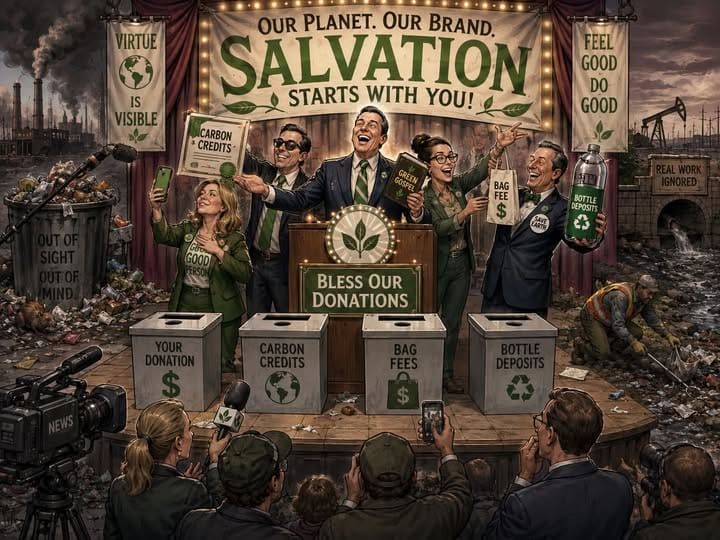
I get dirty looks when I ask for grocery bags. I have to pay for those too. These small fees are a kind of penance or indulgence which absolves me of my environmental sins.
The paper bags and paper straws and recyclable utensils which all fall apart are a small price to pay for a clean soul. Carrying around every can or bottle I buy is my civic duty. Picking up my groceries which fell out of the ripped bag enriches the state, but not my soul.
No one cared that I drove there in an electric rental car, which causes much more environmental damage to make and costs far more per mile to recharge (at least in public spaces). Paper bags and straws take more energy to make. But no matter. The important thing is to feel good.
Common examples of environmental economics:
1. Unredeemed deposits
2. Disposable-bag charges
3. Utility-bill environmental surcharges
4. Renewable-energy certificates and compliance penalties
5. Carbon taxes and cap-and-trade auctions
6. Recycling and disposal fees
7. Vehicle emissions and inspection fees
8. Congestion charges and low-emission zones
9. Plastic, packaging, and extended-producer-responsibility fees
10. Subsidized “green” replacement mandates
A few facts expose cracks in the environmental dogma.
1. Warming has benefits
2. CO₂ promotes plant growth.
3. Earth has been much warmer in the geological past, before industrialization
4. Carbon-credit systems can become redistribution mechanisms
Climate politics adopts recognizable religious forms:
- Original sin: industrial civilization and consumption
- Impurity: an individual “carbon footprint”
- Indulgences: offsets and credits
- Confession: corporate sustainability declarations
- Priesthood: credentialed institutions treated as morally authoritative
- Apocalypse: catastrophic forecasts
- Salvation: sacrifice, restraint, and compliance
- Heresy: questioning policy treated as denial of physical science.
A better and defensible environmental ethic would be:
Favor measurable cleanliness over symbolic purity, direct remediation over moral theater, and demonstrated results over promises of planetary salvation.